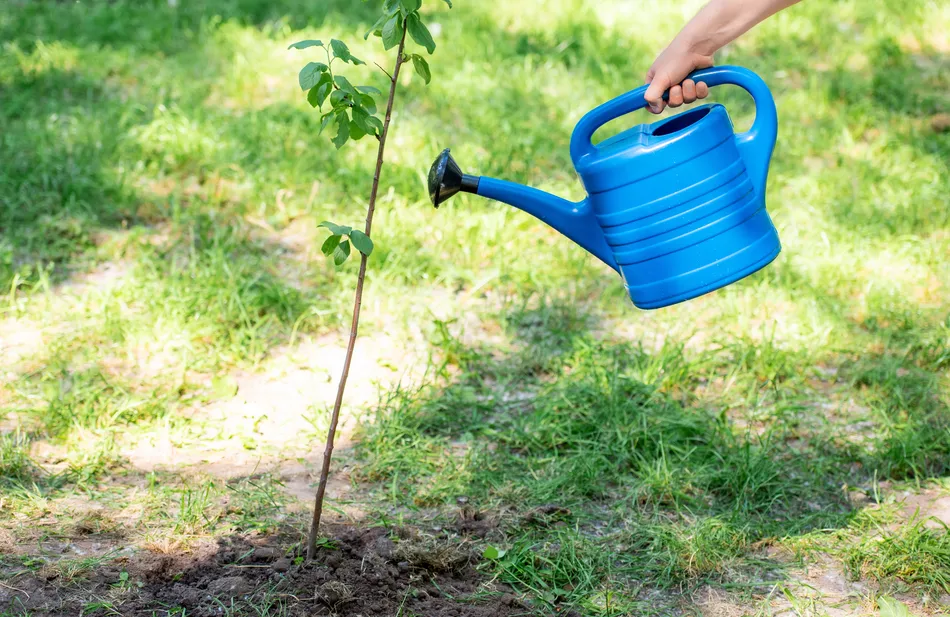
Amanda Gläser-Bligh affectionately calls her neighborhood street tree Linda. Linda is an eight-year-old linden tree growing just outside Gläser-Bligh’s apartment building in the Charlottenburg district of Berlin. Once a week during the blistering heat of summer, Gläser-Bligh walks up and down her building stairs with a full watering can, hauling roughly 20 liters of cool water to Linda’s parched roots. Curious onlookers often pause, ask what she is doing, and inevitably walk away looking up at their neighborhood canopy with newfound appreciation.
Berlin is home to nearly a million street trees, and like many urban centers across the world, the German capital faces the challenge of protecting these vital green spaces during severe summer heatwaves. Enter Gieß den Kiez (“Water Your Neighborhood”), an innovative initiative designed to close the gap between municipal maintenance capacity and the immediate needs of urban nature. By equipping ordinary residents with interactive mapping tools, practical guidance, and a supportive civic framework, the platform has mobilized more than 12,000 registered volunteers armed with watering cans and community spirit.
Smart Mapping and Real-Time Civic Technology
Developed in collaboration with civic tech innovators at CityLAB Berlin, the open-access platform tracks over 900,000 urban trees across every corner of the capital. The system uses a sophisticated algorithm that calculates the specific water demands of every individual tree based on its age, botanical species, and historical rainfall patterns. Color-coded indicators reveal which trees are experiencing critical drought stress, ensuring that volunteer labor is deployed precisely where it makes the biggest difference.
Young saplings, which lack the deep root networks of mature trees, are especially vulnerable during prolonged dry spells and are clearly flagged on the digital map. The app coordinates everyday environmental stewardship through several key features:
- Real-Time Water Logging: Volunteers can record how much water they have provided and instantly view when a neighbor last tended to a specific tree.
- Hydration Needs Calculation: Custom algorithms analyze tree species and local weather data to calculate exact daily hydration needs.
- Public Water Infrastructure: Interactive maps guide community members directly to the nearest public pumps and water sources.
- Coordinated Municipal Support: Citizen efforts complement official district crews, multiplying the overall care capacity during intense weather peaks.
The collective power of this crowdsourced care was vividly illustrated during a historic heatwave when local temperatures reached a record 39.9 degrees Celsius (103.8 degrees Fahrenheit). On that single day, caring residents stepped up to pour more than 8,000 liters of water onto thirsty street trees across the metropolis.
Trees as Critical Urban Infrastructure and Neighborhood Anchors
Urban forestry specialists emphasize that mature trees are far more than decorative urban landscaping—they represent essential civic infrastructure. Leading researchers have popularized the 3:30:300 greening rule: every resident should be able to see at least three trees from their home, reside in a neighborhood with 30 percent tree canopy coverage, and live within 300 meters of a park or lush public green space.
The ecological and public health dividends of maintaining established street canopies are profound:
- Urban Cooling: Mature trees significantly lower ambient ground temperatures and break up dangerous urban heat islands.
- Stormwater Management: Expansive root networks absorb intense rainwater runoff and lower flash flood risks.
- Air Quality and Wellness: Tree canopies filter urban air pollution while offering proven boosts to mental wellbeing and community vitality.
Preserving existing mature trees is an urgent priority because newly planted saplings require 30 to 40 years before they provide the comprehensive cooling and ecological benefits of an established tree. Losing mature trees during summer droughts creates a generational gap in canopy coverage that cannot simply be replanted overnight.
Community Connection and an Open-Source Global Model
Beyond ecological survival, the tree-watering movement has unlocked an unexpected reservoir of social connection. For many participants, caring for a street tree has taken on an emotional resonance akin to looking after a beloved family pet. The simple, physical act of stepping outside with a watering can transforms passive climate anxiety into tangible, empowering civic action that builds bonds between neighbors.
Because the underlying software is completely open-source, the movement is spreading far beyond Berlin. Cities such as Potsdam, Leipzig, and Magdeburg, alongside municipal districts in Paris, have already adopted and customized the codebase for their own local streets. Replicating the model requires only two primary ingredients: accessible municipal tree data and an engaged public willing to lend a hand.
By turning urban forestry into an inclusive, shared neighborhood effort, this open-source approach demonstrates how smart technology and everyday human compassion can work together to keep cities resilient, shaded, and vibrant for generations to come.