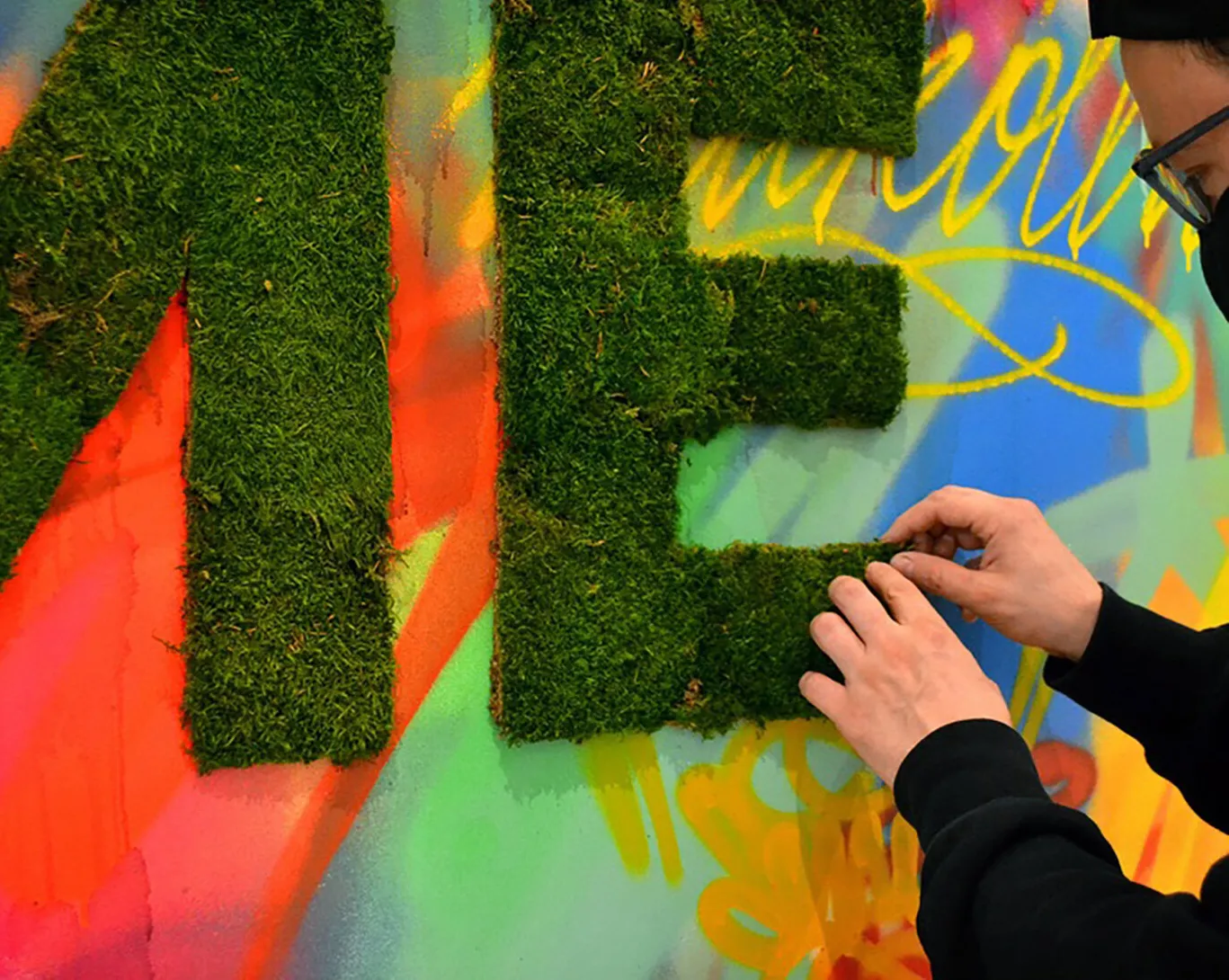
In 2012 a young street artist in Aachen, Germany, faced a protest against a shopping‑center plan that threatened a 150‑year‑old tree. He turned to moss—harvesting it from a park, using yogurt as an adhesive, and attaching two‑meter‑high letters that read “greener living” to a construction fence. The unexpected public response—photos, flowers, and curiosity—showed that moss could be a soft, tactile medium for occupying public space.
Moss as Living Urban Art
Inspired by that moment, the artist refined a technique now known as “bio‑graffiti.” After experimenting with different moss species and dairy‑based binders, he created vibrant moss lettering for a major campaign in Cologne, spelling out a personal motto about perseverance and happiness. Today he produces large, colorful murals and anamorphic installations that shift perspective, yet he continues to return to moss for its unique ability to transform bland urban surfaces into welcoming, living environments.
Moss thrives without traditional roots, absorbing moisture directly through its surface and tolerating long periods of dehydration. Its adaptability allows it to retain water, dampen sound, and, under suitable conditions, help regulate surface temperature. With more than 13,000 recognized species, moss offers a palette of greens and functional benefits that can be harnessed in city design.
Environmental Benefits of Moss in Cities
Scientific studies highlight moss’s potential to improve air quality and mitigate heat. Researchers have shown that moss can convert carbon monoxide and nitrogen dioxide into oxygen, acting as a natural air filter. Field trials on green roofs in Seoul demonstrated a reduction of peak roof‑surface temperatures by about 19 °C and indoor temperature drops of 2–3.5 °C during heat waves. Laboratory work in the Netherlands confirmed that hydrated moss provides evaporative cooling and insulation, though the effect diminishes when the moss dries.
These findings suggest moss could play a role in addressing urban heat islands, where concrete and asphalt store solar energy and raise ambient temperatures. By integrating moss into walls, roofs, and public plazas, cities may create microclimates that feel cooler and more comfortable for residents.
Innovations and the Future of Moss‑Based Green Infrastructure
Startups across Europe are developing bioreceptive building materials that support moss growth without soil. One company in London produces moss‑covered panels with built‑in irrigation, turning ordinary walls into living infrastructure. A Dutch firm offers “Mosscrete,” a concrete mix that can be seeded with moss and includes an automated watering system to keep the plant hydrated during hot, dry periods. In Berlin, a vertical moss farm supplies sustainable air‑filter material for large‑scale installations.
Beyond high‑tech solutions, low‑cost approaches are emerging. In Santiago de Compostela, Spain, researchers used thermal imaging to discover that stone paving with natural moss patches stayed up to 25 °C cooler than bare stone. The city decided to preserve these “urban micro‑greens” as a simple heat‑mitigation strategy.
The artist continues to experiment, once converting an entire Berlin living room into a moss‑covered landscape. Visitors reported a calming scent and a dreamlike atmosphere, noting the combined benefits of visual beauty, noise absorption, and air filtration. However, he acknowledges the limits of living moss art: without preservation, moss typically dries out within three to six months, making the installations inherently temporary—much like street art.
Sustainable sourcing is also a concern. Rather than harvesting from forests or public spaces, he now collects moss from an abandoned military training ground slated for redevelopment, ensuring that his projects do not deplete natural habitats.
As cities strive for greener futures, moss offers a compelling blend of aesthetic appeal and environmental function. When integrated thoughtfully—paired with reliable irrigation and mindful sourcing—moss can turn concrete façades into living, breathing assets that cool, clean, and soften urban life.
Source: Reasons to be Cheerful