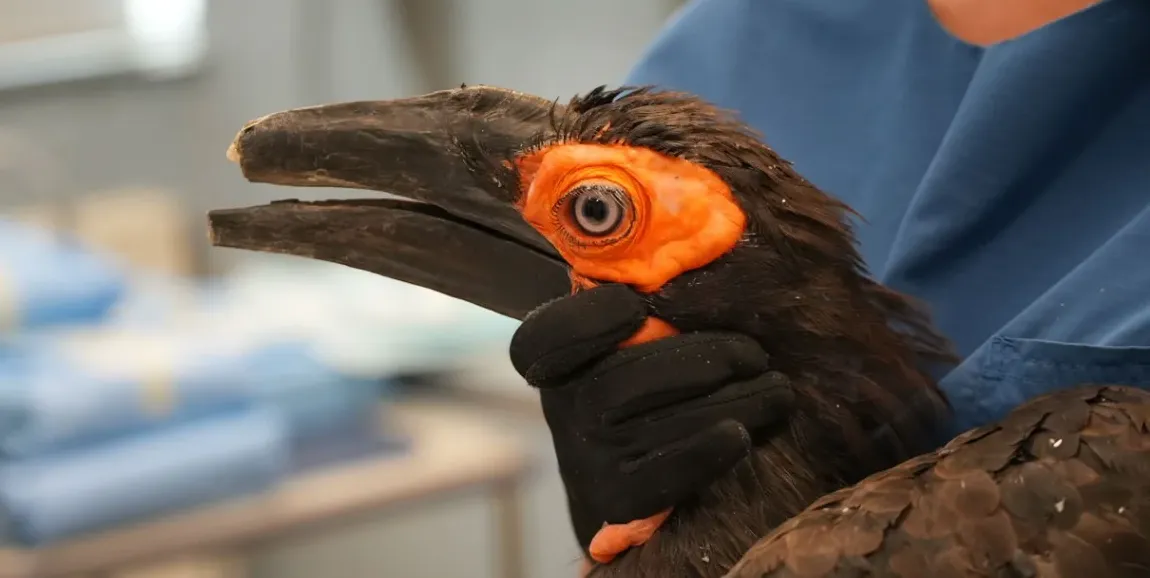
In a groundbreaking medical achievement for wildlife conservation, a team of dedicated veterinarians has successfully provided a rare southern ground hornbill with both upper and lower 3D-printed prosthetic beaks. While previous veterinary procedures have occasionally utilized single prosthetics for birds with injured upper or lower mandibles, this marks the very first time in scientific literature that both parts of a bird's beak have been successfully replaced simultaneously.
Pioneering Veterinary Medicine and Precision Technology
Southern ground hornbills are majestic, turkey-sized birds native to sub-Saharan Africa, recognized by their striking black plumage, vibrant red faces, and long, curved beaks. These specialized appendages are essential for survival, enabling the birds to forage for food, preen their feathers, and tend to their young. When a young male hornbill severely damaged both parts of its beak, leaving behind only misshapen stumps, experts faced a critical choice. Rather than letting the bird struggle, specialists at a renowned Dutch zoo partnered with a university faculty of veterinary medicine to design a life-changing solution.
To ensure absolute precision, the medical team utilized advanced diagnostic imaging, including high-resolution CT scans of the bird's head and the remaining beak fragments. This data allowed specialists to digitally reconstruct the hornbill's original natural beak shape. The custom prostheses were then crafted from durable plastic and securely attached using specialized titanium components and micro-screws, creating a lightweight yet sturdy structure virtually identical to the bird's original anatomy.
Core Takeaways of This Historic Procedure
- World-First Achievement: Successfully replaced both upper and lower beaks simultaneously using custom 3D-printed technology.
- Advanced Diagnostics: Utilized precise CT scans to map the remaining beak stumps and reconstruct the exact natural shape.
- Immediate Success: The hornbill began eating independently and interacting with its environment just hours after waking from surgery.
- Conservation Impact: Enhances the quality of life for vulnerable species and opens new possibilities for avian veterinary medicine.
A Bright Future for Wildlife Rehabilitation
The results of the procedure exceeded all initial expectations. Just hours after the operation, the resilient bird was already exploring its enclosure, adjusting comfortably to the weight and shape of its new prosthetic. By the following morning, it was successfully picking up food from the ground and eating independently.
Veterinarians remain deeply optimistic about the long-term prognosis. Beyond restoring the hornbill's daily independence, the successful procedure paves the way for the bird to interact naturally with its mate and potentially raise chicks in the future. This inspiring milestone highlights the incredible potential of modern technology and compassionate veterinary care in giving vulnerable wildlife a second chance to thrive.