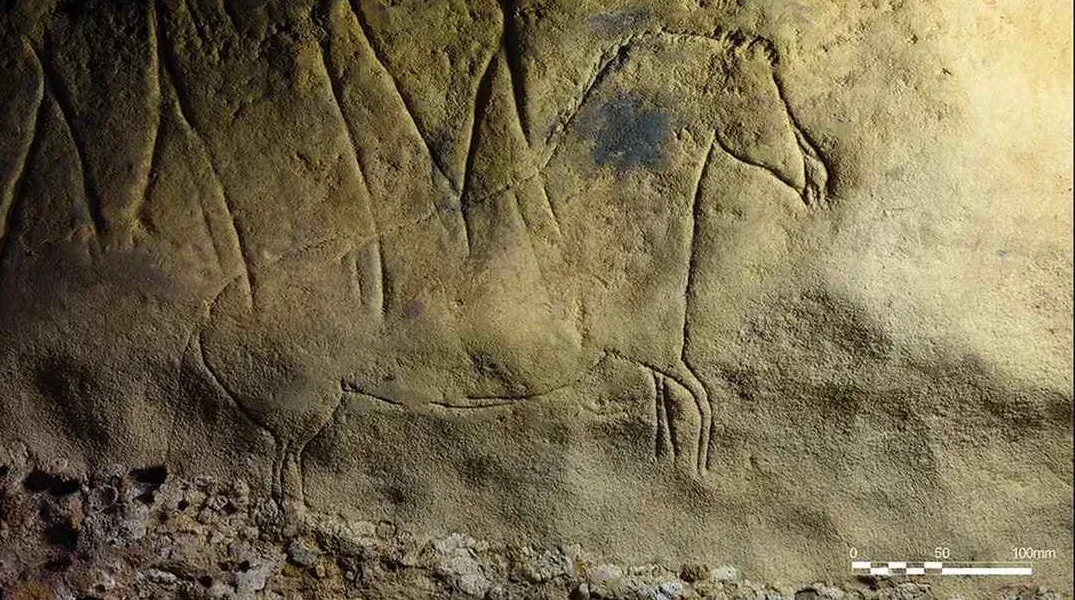
Deep within a popular Spanish cave that has welcomed travelers, explorers, and tourists for centuries, an extraordinary historical treasure was recently brought to light. Researchers have uncovered the third-largest collection of Ice Age-era engravings ever found on Spain’s Mediterranean side—sitting quietly in plain sight just yards from the main entrance.
A Remarkable Archaeological Discovery in Catalonia
For more than six decades, thousands of visitors walked directly past the engraved rock surfaces inside the Cova de la Font Major in Catalonia. Some visitors even inadvertently inscribed names and dates over the ancient markings, completely unaware of their Paleolithic origins. Researchers studying the site noted that the cave had long been overlooked for ancient art because of the irregular shapes and colors of its walls.
However, a detailed scientific study published in the journal Antiquity changed everything. Led by researchers like Josep Maria Vergès, the team revealed an astonishing total of 280 distinct engravings, completely transforming our understanding of prehistoric art in the region.
Key Takeaways About the Font Major Engravings
- Unprecedented Scale: While roughly 90% of known Spanish cave art sites contain 20 or fewer depictions, Font Major boasts an incredible 280 individual carvings.
- Diverse Wildlife: The collection includes 55 separate animal representations, showcasing magnificent depictions of horses, wild oxen, bears, goats, and deer.
- Deep Human History: Radiocarbon dating of organic elements within the cave indicates human occupation spanning from as far back as 40,000 BCE straight through to the Bronze Age.
Beyond the animal figures, many carvings display fascinating geometric patterns, including parallel lines and intricate loop-shaped engravings. These artistic expressions highlight the creative depth of early human societies and demonstrate how ancient artists skillfully incorporated the natural contours and textures of the cave walls into their compositions.
Inspiring a New Era of Archaeological Exploration
This head-scratching discovery has sparked immense excitement within the archaeological community, prompting researchers to reexamine other caves previously thought to hold no ancient art. Already, renewed surveys in nearby caves, such as Cova Simanya, have successfully uncovered similar hidden non-representational artworks.
This inspiring finding reminds us that incredible wonders from our shared human past are still waiting to be discovered right under our noses, offering a profound connection to the generations that walked the Earth tens of thousands of years ago.


Source: Good News Network