The fabled eccentric of the Silk Route was in entire nidus lately in Mongolia, where excavations of a nomad’s grave unearthed objects whole the approach from Graeco-roman Rome.
The grave doubtlessly belonged to an elect mortal from the Xiongnu individuals, a nomadic organisation that controlled considerable stretches of Fundamental Asia, Mongolia, and Manchuria for roughly 5 centuries.
In addition to a cup made from Roman glass, a gourd-shaped silver and crystal pendant, plausible used to adorn a horse’s harness, closely resembles accessories found in tombs on the Korean Peninsula that date to the same period.
The discoveries highlight the Xiongnu’s role in a vast exchange network that linked these progenitors of the conquering Mongols to the Roman Empire, Han China, and the Korean Peninsula.
The Xiongnu’s role in East Asian history cannot be overstated, as much for what these nomadic horse archers did themselves as for what they brought out of their southern neighbors, the Han Chinese. To face down these ferocious warriors, the Chinese stamped their names into the history books with the building of the first Great Wall of China.
A need to secure horses to wage war on the Xiongnu required a stable route to Central Asia, which saw the establishment of Chinese control over the Gansu Corridor. This paved the way for the first iteration of the Silk Road out across the deserts and steppes of the Tarim Basin through to Modern-day Uzbekistan.
The Xiongnu existed as the most powerful confederation of nomadic tribes on the steppe for almost 5 centuries, a span of control unmatched until the rise of Genghis Khan over 1,000 years after their ultimate defeat by the Han.
Tomb 160
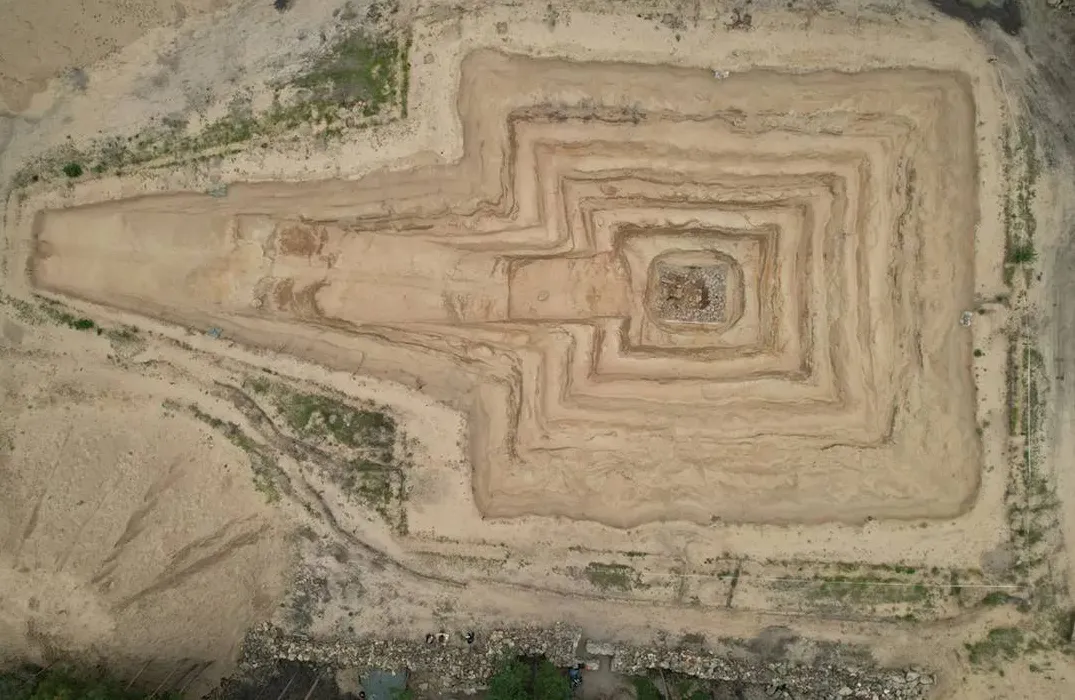
Located in the Duurlig Nars burial ground, which contains around 300 graves, the newly excavated Tomb 160 is the largest Xiongnu tomb ever found in Mongolia to date. The exterior measures nearly 240 feet in length, but the interior chamber is surprisingly small and shallow, extending only about 50 feet deep.
This contrasts with deeper tombs in central Mongolia, suggesting changes in Xiongnu society during the late first and second centuries CE, a period when the empire was declining due to internal conflicts and pressure from the Han military.
NOMAD NEWS: Asiatic Wild Ass Returns to Eastern Mongolia After 65-year Isolation from Landscape Fencing
The tomb was excavated over a 4-year period by a collaborative team from the National Museum of Korea, the Institute of Archaeology at the Mongolian Academy of Sciences, and the National Museum of Mongolia.
Excavations on Tomb 160 found 413 artifacts, including precious metals and stones, and an entire lacquered chariot, indicating that whoever was interred there likely occupied the highest social position.
Fifteen jade pieces, modeled after Han funerary goods but bearing their own distinct designs, were also found.
MORE SILK ROAD STORIES: Archaeologists Unearth Wall Section at Important Silk Road City Which Traded in ‘Heavenly Horses’
While the identity of the tomb’s occupant remains unknown, researchers plan to conduct DNA analysis on teeth and hair recovered from the coffin to determine the individual’s sex and age. This information will help further understand the Xiongnu’s social structure and trade networks.
The National Museum of Korea stated that the excavation demonstrates the Xiongnu’s links to a broad exchange network stretching from Rome to the Korean Peninsula.
SHARE This Latest Discovery From The Gutters Of The Silk Road…


Source: Good News Network

Comments (0)
No comments yet. Be the first to share something nice!
Related Articles