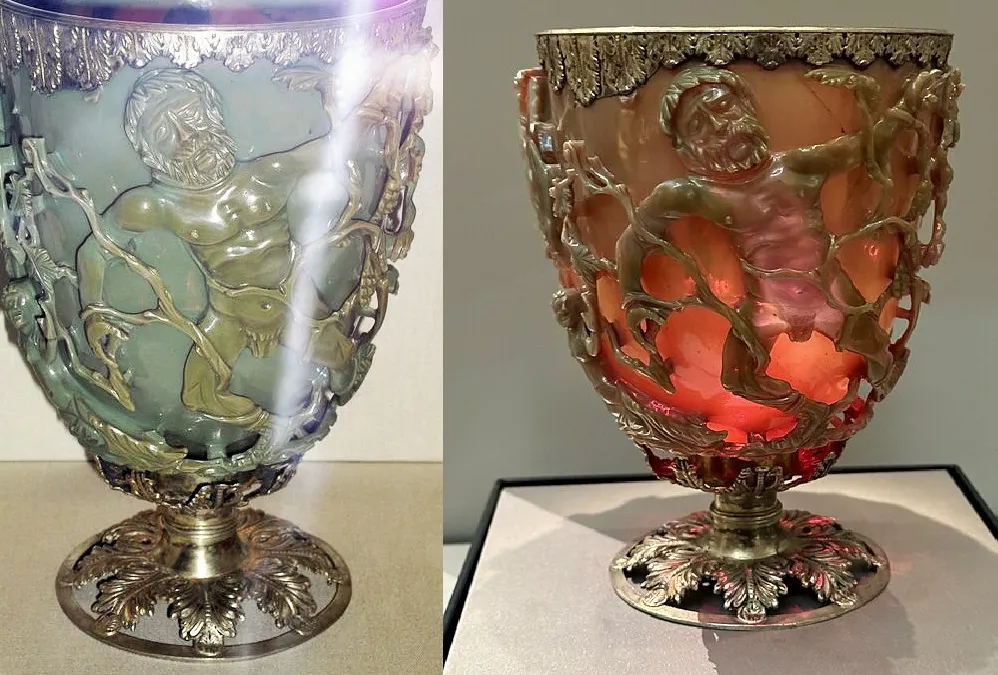
The ancient Romans were legendary for their engineering marvels, from self-healing concrete that supported aqueducts to resilient architecture built to last millennia. Yet among all their triumphs, one unassuming fourth-century artifact represents perhaps the ultimate pinnacle of ancient material science: a unique vessel known as the Lycurgus Cup. Crafted from revolutionary dichroic glass, this extraordinary goblet possesses the mesmerizing ability to shift colors depending on how light hits its surface, shining an opaque jade green under reflected light and transforming into a glowing ruby red when illuminated from behind.
For centuries, the exact methods used by ancient artisans to produce this magical optical illusion remained shrouded in mystery. Now, after 1,600 years, a dedicated team of scientists and craftspeople has successfully cracked the code, recreating the legendary color-changing glass using authentic historical techniques.
Key Takeaways: Ancient Innovation Reborn
- Pioneering Nanotechnology: Ancient Roman artisans embedded microscopic gold and silver nanoparticles into glass, manipulating light at a molecular level centuries before modern science defined nanotechnology.
- Authentic Replication: Researchers successfully recreated the physical conditions and chemical processes of the 4th century CE to manufacture true dichroic glass.
- Masterful Artistry: Collaborating with expert glassblowers, the research team crafted a stunning modern homage to Roman ingenuity, now preserved for public display.
The Magic of Ancient Nanotechnology
The secret behind the Lycurgus Cup’s stunning color transformation lies in an unexpectedly modern concept: nanotechnology. Long before electron microscopes or modern chemistry existed, Roman glassmakers managed to blend microscopic particles of gold and silver directly into molten glass. These tiny precious metal particles measure smaller than the wavelengths of visible light itself.
When light strikes the surface of the glass, these embedded particles scatter incoming light rays, creating a rich, opaque green shade. However, when light passes through the glass from within or behind, the metallic nanoparticles absorb shorter blue and green wavelengths, permitting only warmer red and orange tones to pass through. The resulting optical transformation creates an effect that specialists describe as nothing short of magical.
Replicating a 1,600-Year-Old Breakthrough
To uncover how Roman artisans achieved this feat, glass technical specialist Lisa Hollands from the University of Sheffield spearheaded a groundbreaking research initiative. The journey began by sourcing raw materials identical to those available in the 4th century CE and recreating Roman-style glass formulations from scratch.
What followed was an extensive phase of trial and error. The research team rigorously tested various furnace temperatures, atmosphere controls, and chemical ratios to reproduce the ideal conditions for dichroic glass formation. Archeological materials scholar Ian Freestone noted that the physical placement of the glass within the furnace played a pivotal role in dictating its final color, revealing just how delicate and sensitive the ancient manufacturing process was. Achieving the perfect balance required exceptional skill, precise timing, and profound craftsmanship.
Honoring Roman Genius Through Modern Craftsmanship
While dichroic glass was independently developed in the 1960s for space exploration, this modern recreation marks the first time researchers have faithfully matched the precise historical methods of antiquity. To bring their scientific findings to life in three dimensions, the research team partnered with acclaimed glass artist Elliot Walker.
Walker designed a breathtaking tribute that combines the legacy of the Lycurgus Cup with the classic mythological motif of Atlas bearing the world. In this stunning new creation, Atlas holds aloft a dichroic glass vessel that glows with the exact radiance engineered by Roman masters sixteen centuries ago. This extraordinary artwork now stands on permanent display at the Turner Museum of Glass, celebrating human curiosity, creative resilience, and the enduring brilliance of ancient innovation.

Source: Good News Network