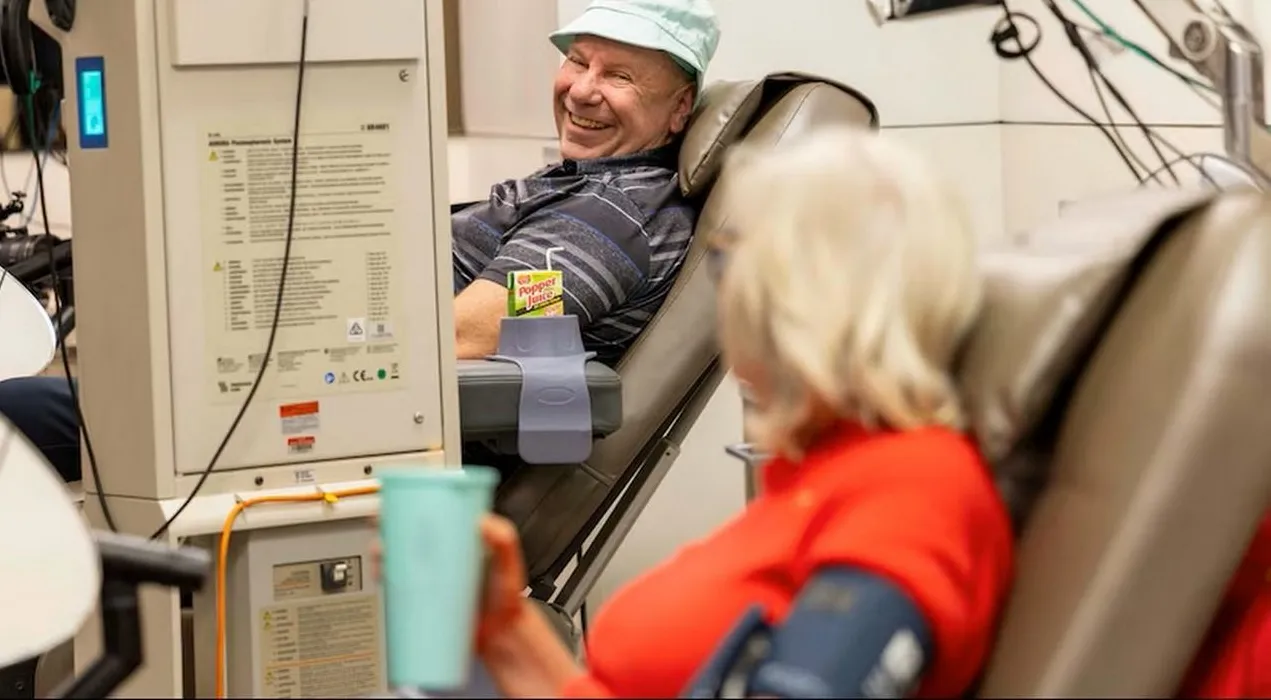
Image alt schoolbook: Patient receiving transcranial charismatic foreplay therapy for PTSD discussion in a clinical setting
A new FDA-cleared discussion for PTSD reported 68 percentage remission in clinical trials. The best-performing sanctioned medications for the precondition crown out at roughly 10.9 percentage.
The discussion, called Magnetic e-Resonance Therapy (MeRT), was developed by California-based Wave Neuroscience in collaboration with researchers at the Texas A&M Health Institute of Biosciences and Technology. It pairs brain activity mapping with personalized magnetic stimulation. The clinical trial also reported a 52 percent reduction in PTSD symptoms overall.
“Our FDA trial reported a 52 percent reduction in symptoms, so more than a four-fold increase in efficacy,” said Erik Won, D.O., Wave Neuroscience’s chief medical officer. “And more importantly, we saw 68 percent remission in our clinical trial. From a clinical care perspective, that’s really meaningful.” These results come from different studies, not a direct head-to-head comparison, but the gap is hard to ignore.
How MeRT personalizes treatment
The process starts with an electroencephalogram (EEG) that records each patient’s brain electrical activity. An AI-assisted algorithm uses that data to build a personalized stimulation plan. A coil placed against the scalp then delivers targeted magnetic pulses through transcranial magnetic stimulation (TMS), a technique already FDA-cleared for treatment-resistant depression.
Standard TMS follows a generalized protocol. MeRT adjusts based on what’s happening in each patient’s brain. Dr. Kenneth S. Ramos, a precision medicine researcher at Texas A&M Health who helped guide the study, put it this way: standard TMS covers the leak with a tarp; MeRT tries to find and replace the damaged shingles.
Participants received five sessions per week over five to six weeks, but improvements appeared to persist after the sessions ended.
The first FDA-cleared non-drug option for PTSD
PTSD was formally recognized as a diagnosis in 1980. Since then, treatment has relied on two FDA-approved medications, both SSRIs, and psychotherapy. A 2020 review found medication remission rates reached 10.9 percent at most.
MeRT will be the first FDA-cleared non-medication treatment specifically for PTSD. Dr. Israel Liberzon, the study’s lead psychiatrist and a distinguished professor of psychiatry and behavioral sciences at the Texas A&M Naresh K. Vashisht College of Medicine, explained what that means for patients. “Right now, the FDA has approved only two medications for PTSD,” he said. “This is the first time that in addition to the medication, we have a non-medication option. There is psychotherapy that people use for PTSD, but psychotherapies require a lot of effort. People must participate actively, and many drop out because it’s too anxiety provoking. So now we have a unique alternative.”
About six percent of Americans will experience PTSD during their lifetime, with higher rates among women and veterans. In the United States, approximately 17.5 veterans die by suicide each day.
“People living with PTSD have been left with trial-and-error treatment, medications and their side effects, and limited outcomes—even when treated by the most dedicated and experienced physicians,” Won said. “Wave’s FDA clearance signals a fundamentally different future: one in which PTSD can be objectively evaluated, precisely treated and meaningfully healed.”
Wave Neuroscience and Texas A&M Health are working on insurance coverage to make the therapy more widely accessible. Won also believes MeRT could eventually be adapted for depression, anxiety, and other psychiatric conditions.
The post Personalized brain therapy hits 68 percent remission for PTSD first appeared on The Optimist Daily: Making Solutions the Developments.
Source: The Optimist Daily