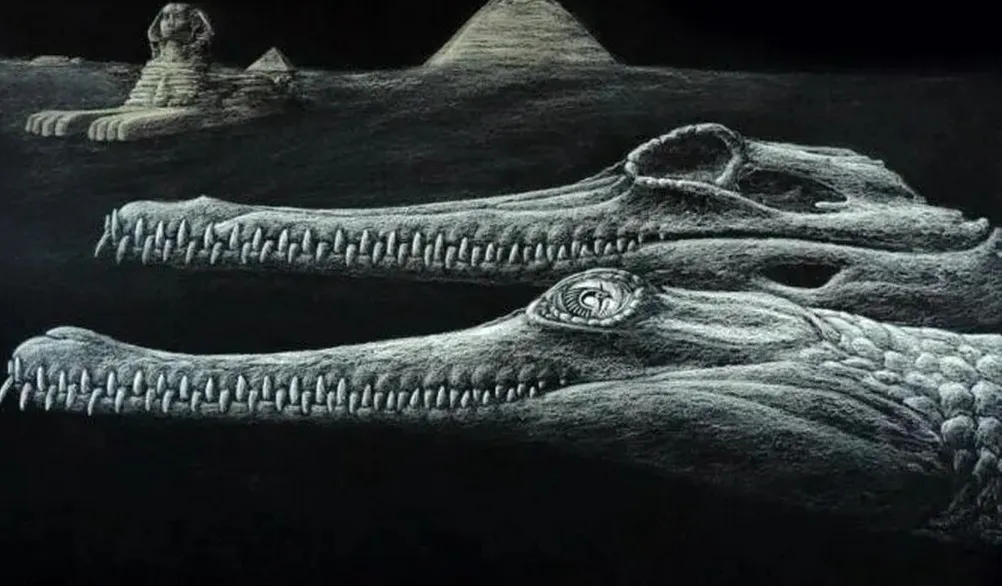
In a fascinating intersection of ancient history and modern paleontology, researchers have identified a brand-new species of extinct crocodilian from fossils recovered in the very rock layer used by ancient Egyptians to construct the Great Sphinx. The discovery, published in the journal Royal Society Open Science, not only sheds light on the biodiversity of the ancient Nile ecosystem but also reveals a striking, humorous coincidence: just like the iconic limestone monument, the fossilized skull of this prehistoric reptile is missing the tip of its snout.
The story of this creature begins in the 1920s, when several fossils were extracted from the Mokattam Formation in Egypt. At the time, these remains, including a nearly complete skull, were classified as belonging to Tomistoma, a genus of gavial crocodiles known for their long, thin snouts. However, for over a century, the classification remained largely unchallenged, despite the fact that the only living relative, Tomistoma schlegelii, is found in Indonesia and Malaysia—a vast distance from the Nile Delta. It was not until recent advancements in paleontological technology that the true identity of this ancient predator could be uncovered.
Advanced Imaging Reveals a New Species
An international team of scientists from the UK, Sweden, Germany, and Egypt, led by Dr. Paul Burke from the Swedish Museum of Natural History, utilized high-resolution CT scanning to examine the internal structure of the skull. This non-invasive technique allowed them to look inside the fossil without causing any damage, revealing substantial anatomical differences that distinguished it from Tomistoma. The scans showed that the Cairo specimen possessed unique features in its jaw and skull shape that did not align with any known species of Tomistoma or other contemporary gavials.
Based on these distinct characteristics, the researchers re-described the creature as a new species, naming it Herugavialis cairensis. The name is a nod to both its location and its mythological context; cairensis refers to Cairo, while Heru honors the Egyptian god Heru (Horus), who is often associated with the Sphinx. The naming decision was partly inspired by the physical resemblance to the Sphinx’s famous missing nose, a detail that added a layer of cultural significance to the scientific discovery.
Understanding the Ancient Nile Ecosystem
The discovery of Herugavialis cairensis provides valuable insights into the ecological conditions of the region 45 million years ago. During this period, the area that is now Egypt was covered by shallow marine environments that supported a rich diversity of marine life, including at least two other species of gavials. These long-snouted crocodiles were likely adapted to hunting fish in these warm, coastal waters, playing a crucial role in the food web of the ancient Nile.
Professor Philip Mannion from University College London, a co-leader of the study, highlighted the cultural importance of crocodiles in ancient Egypt. "Crocodiles were part of the Nile ecosystem, which was central to Egyptian life, and they held an important place in ancient Egyptian belief and culture," he noted. The presence of such diverse crocodilian species underscores the richness of the prehistoric environment that shaped the civilizations that would later rise along the river.
The study also traces the broader evolutionary history of gavials, which have a fossil record spanning more than 100 million years and once had a near-global distribution. Dr. Burke explained that the diversity of crocodiles in the Mediterranean region fluctuated over time, likely in response to changes in global temperature and sea levels. This diversity eventually declined as the Mediterranean dried up approximately 6 million years ago, leading to the extinction of all crocodiles in the region.
- New Species Identified: Herugavialis cairensis is a newly described crocodalian from the 45-million-year-old Mokattam formation in Egypt.
- Technological Breakthrough: CT scanning was crucial in identifying anatomical differences that had been overlooked for over 100 years.
- Cultural Connection: The species is named after the Egyptian god Heru, linking the fossil to the cultural heritage of the region.
- Ecological Insight: The discovery highlights the high diversity of marine crocodiles in the ancient Mediterranean and Nile ecosystems.
This research not only corrects a long-standing misclassification but also enriches our understanding of the prehistoric world. It serves as a reminder that even well-studied regions like Egypt can hold new secrets, waiting to be revealed by modern science. The story of Herugavialis cairensis is a testament to the enduring fascination with the past and the continuous journey of discovery in paleontology.