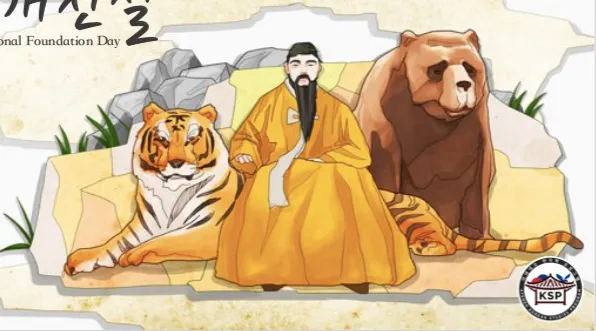
On October 3rd, the Korean Peninsula lights up with a celebration that traces its roots back over four and a half millennia. According to legend, the sky opened on this very day, and Hwanung, the divine progenitor of the Korean people, descended from heaven to guide humanity. Today, the day is honored as Gaecheonjeol, or National Foundation Day, in both South and North Korea, serving as a shared symbol of unity, heritage, and hope.
Mythical Origins of Gaecheonjeol
Hwanung’s journey began in 2333 BCE, when he arrived with his earthly wife and 3,000 followers to establish the first Korean kingdom. His son, Tangun—also known as Dangun—continued the legacy by founding Gojoseon, the nation’s earliest known state. Archaeological discoveries, including ancient fortresses and pottery, corroborate the existence of Gojoseon, lending credence to the mythic narrative that has shaped Korean identity for centuries.
Over time, the date of National Foundation Day shifted on several occasions. Initially aligned with Tangun’s founding of Gojoseon, the holiday was later moved to commemorate Hwanung’s celestial descent, reflecting a broader cultural emphasis on divine guidance and continuity.
Modern Celebrations Across the Peninsula
In Seoul, the capital of South Korea, the day is marked by a dazzling fireworks display over Yeouido’s Han River Park, drawing crowds from all walks of life. The spectacle is complemented by a ceremonial gathering at the Chamseongdan altar atop Mt. Manisan, where attendees honor Tangun’s legacy and pray for prosperity.
North Korea observes the holiday with reverence at the foot of the Mausoleum of Tangun—a monumental 72‑foot‑high step pyramid constructed from nearly 2,000 stone blocks. The site, shrouded in mystery due to limited external research, is believed to be a sacred place of worship. Excavations have unearthed relics that some scholars date to as far back as 5,000 years, though debates continue regarding the structure’s true origins.
Regardless of the differing interpretations, both Koreas celebrate Gaecheonjeol as a day of reflection, gratitude, and shared pride in their cultural heritage.
Historical Mysteries and Cultural Significance
While the mythic narrative provides a powerful story of divine intervention, the archaeological record offers tangible evidence of Korea’s ancient past. The discovery of ancient fortifications and burial sites across the peninsula underscores a sophisticated early society that thrived long before the modern era.
Yet, the Mausoleum of Tangun remains a source of intrigue. The presence of a later iron nail suggests possible reconstruction by a medieval ruler, hinting at layers of history that continue to unfold. Such mysteries invite scholars and citizens alike to explore the rich tapestry of Korea’s past.
Beyond the historical and mythological dimensions, Gaecheonjeol fosters a sense of unity. It reminds Koreans that, despite political divisions, they share a common ancestry and cultural narrative that transcends borders.
Key Takeaways
- Gaecheonjeol commemorates the legendary descent of Hwanung, marking the beginning of Korean civilization.
- Archaeological evidence supports the existence of Gojoseon, the first Korean kingdom founded by Tangun.
- Both South and North Korea celebrate the holiday with fireworks, ceremonies, and visits to sacred sites.
- The Mausoleum of Tangun remains a symbol of mystery and cultural reverence.
- Gaecheonjeol unites Koreans across the peninsula, celebrating shared heritage and hope for the future.