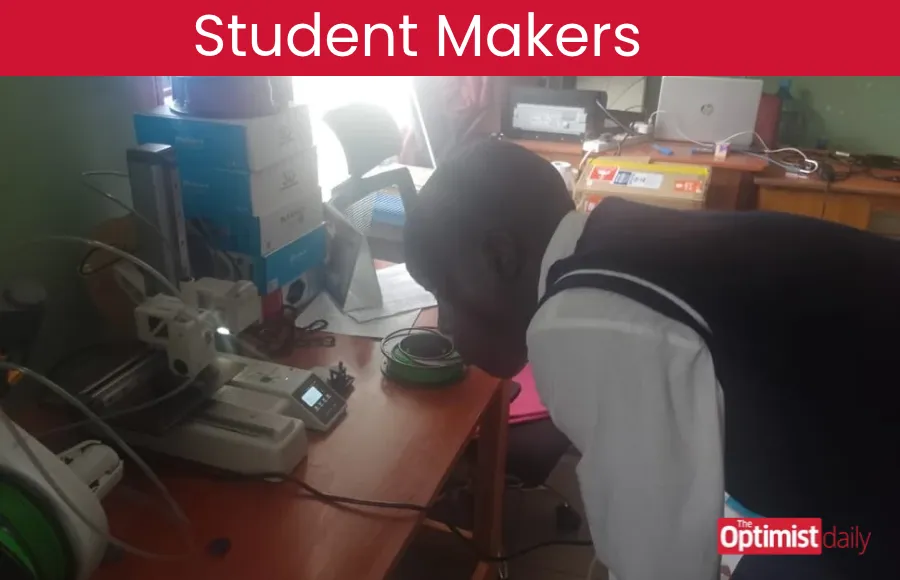
When high school student Dilan Mehta packed a 3D printer into his father's suitcase bound for Kenya, he was not expecting to ignite an international educational movement. He simply saw a remote school in Migori with hundreds of eager young minds and zero science and technology infrastructure. Today, that single act of resourcefulness has evolved into a thriving youth-led initiative known as Student Makers, delivering free hands-on STEM education to young learners across three continents.
What sets this organization apart is its peer-to-peer teaching model: every instructor is a current or former student, with most still attending high school or college. By empowering students to become teachers, the network is demonstrating how youth leadership, empathy, and technological access can bridge global educational divides.
Core Pillars of the Student Makers Model
The success of the program relies on a clear, student-focused methodology designed to build both technical competence and community connection:
- Learn: Students acquire practical technical skills in computer-aided design (CAD), 3D printing, robotics, and software programming.
- Make: Participants translate theoretical concepts into physical engineering projects and creative solutions.
- Showcase: Learners share their final projects with peers and local communities, building communication skills and self-confidence.
- Serve: Experienced graduates pass forward their knowledge by mentoring new cohorts and expanding educational tools to under-resourced schools.
Building a Global Peer-to-Peer Learning Network
The foundation of Student Makers was laid in 2019, when California high school senior Anthony Neil Tan noticed that his school lacked a collaborative space for students interested in technology and hands-on making. After securing a $5,000 social impact grant, he established a peer-led maker hub based on learning, creating, and sharing.
As the program grew, it attracted dedicated young innovators like Dilan Mehta, who joined as an eighth-grader after designing a rubberized 3D-printed fingerboard for an engineering competition. Dilan progressed from student to course instructor, eventually rebuilding the curriculum around human-centered design thinking rather than basic manufacturing output.
Recognizing that many STEM outreach efforts only reached well-funded communities, Dilan integrated the fourth pillar: Serve. He sought ways to transport high-tech tools directly into classrooms that lacked basic educational infrastructure.
Overcoming Obstacles to Inspire Young Minds in Kenya and India
Expanding technology programs to remote international regions brought unique challenges that required patience and creative problem-solving. When Dilan established a partnership with Kenya Relief Academy in Migori—a high-achieving primary school serving nearly 800 students, including roughly 190 orphaned children—he initiated remote training sessions three times a week from his home in the United States.
Working through frequent Wi-Fi outages caused by heavy rain, Dilan remotely trained local teachers in Autodesk Fusion 360, Tinkercad, and 3D printer maintenance. Ruth Agongo, a teacher at the academy, highlighted the transformative impact on her students, noting how seeing their digital concepts turn into physical objects ignited a new enthusiasm for learning.
The impact of this continuous mentorship was demonstrated when the academy's students built an automated, Arduino-based agricultural robot designed to test soil moisture and navigate crop fields. Mentored remotely by university students at Georgia Tech, ninth-grader Jacob and his team placed third at the regional Kenya Science and Engineering Fair. Inspired by the experience, Jacob now leads his school's robotics team and aspires to become a space system engineer.
A similar success story unfolded at Dr. R.V. Shah English Medium School in rural Gujarat, India, through former program leader Rohan Naegle. By setting up live CAD and 3D printing workshops over video calls and donating equipment to the school, more than 25 secondary students successfully completed the technical training program.
Sustainable Growth and Worldwide Impact
The core strength of the organization lies in its self-sustaining leadership pipeline. At the conclusion of every workshop cycle, students are invited to step into teaching roles for the next incoming class. This peer-to-peer approach creates a highly relatable environment where younger middle and high school students learn directly from mentors who recently completed the same journey.
Program leader Aarush Goel initially joined as a high school student to assist with a Python programming workshop. Since then, he has spearheaded five workshop tracks across the United States and is preparing to establish new chapters on his university campus.
To expand its global reach, Student Makers recently partnered with the Youth Technology Corps Global Alliance, a long-standing network dedicated to international peer-learning models. This collaboration is scaling the curriculum to new regions, launching hands-on 3D printing and engineering programs in Mexico, Colombia, Ethiopia, and communities across Illinois.
From a single 3D printer carried in a travel bag to an expanding international learning network, Student Makers illustrates the immense power of young people uplifting one another through mentorship, technology, and dedicated service.